
Activities at NIFHS
North of Ireland Family History Society (NIFHS) AGM: 15th August 2026 at 2pm via Zoom Members are cordially invited to attend the Society’s AGM, followed
North of Ireland Family History Society (NIFHS) AGM: 15th August 2026 at 2pm via Zoom Members are cordially invited to attend the Society’s AGM, followed
In this section, you have access to copies of the handouts that were used in a number of our lectures.
2026-02-17
Michael provided a practical demonstration on using Word and PowerPoint to create interesting and informative books of your family history research. He covered how to set up your page orientation and margins, copying and pasting images and family trees, inserting text boxes and highlighting areas on the page.
See part 1 below for the PowerPoint family tree template used in the presentation.
Watch a recording of Michael’s talk: Recording
2026-01-20
Martin’s talk was a follow on from his introductory talk on DNA given last June. In this talk he focused on how you can map your chromosomes in order to build up a picture illustrating which segments of DNA on which chromosomes you inherited from which ancestors. This is possible by using the chromosome information provided on FamilyTreeDNA, MyHeritage and GEDMatch sites and compiling using tools on the DNA Painter website.
Once mapped, you can use the information to compare where unknown DNA “cousins” match you and so deduce which ancestral lines you and the match have in common.
Watch a recording of Martin’s talk: Recording
2025-11-22
Michael provided a practical demonstration on creating images for use in your family history books. Most of us carry an excellent camera in our hands every day – our mobile phones. Dependent on your make and model, many phones provide multiple lenses and include software apps to post-produce your photos to the highest quality. It’s worth getting to grips with using these editing tools – especially working with the brilliance settings and vignette.
Taking a good phot is all about LIGHT. Michael illustrated how natural light can be used, preferably not direct bright sunlight but somewhat shaded aspects, to bring out the important qualities in your subject. Try to capture human faces which glimmer with certain features highlighted. Take a look at how Vermeer painted his subjects – always side-lit from a window.
Michael also covered how to take screenshots of your online records, ready for inclusion in your books.
We all have family artefacts and Michael demonstrated the best way to capture photographs of those objects.
Watch a recording of Michael’s talk: Recording
2025-11-01
Estate Records for Genealogy – Dr Declan Brady
Declan discussed the various types of land records available for genealogical research in Ireland, including Griffith’s Valuation, landowner lists, and estate papers. He explained how these records can be used to trace ancestors, particularly those involved in land rental businesses. Declan highlighted the importance of thinking broadly when searching estate records and suggested looking at personal and political correspondence, as well as legal documents and maps. He also advised on where to find these records, including the National Library, National Archives, and various online databases. Declan emphasized the value of using public libraries and archives to access these resources. Declan discussed the vast collection of private papers and estate records available for research, emphasizing the nuanced nature of historical figures who were both notorious and beloved by their tenants. He highlighted the importance of philanthropy often overlooked in historical narratives and shared insights into the political dynamics of the time, including the strategic use of information and connections.
Dublin City Library and Archives Collections – Tara Doyle
Tara discussed the challenges and processes involved in managing and digitizing historical records, including electoral rolls and other archives. She highlighted the need for technical support to make these records accessible online and mentioned that some records are already available on platforms like Find My Past. Tara also touched on the importance of archiving “born digital” content such as websites and social media content, referencing the National Library’s efforts in this area since 2011. She emphasized the role of archivists in appraising and cataloging new acquisitions, as well as the challenges of managing personal data in historical records.
Dublin Directories – Roy Atkinson
Roy discussed the potential of using various directories as a genealogical resource. A lot of the very early directories started off with the British Empire and related positions, lists of names of people associated with the House of Commons, Parliament, Civil Service, Army, Navy and the Coast Guard. Such directories often contained details of places, including land areas. Roy explained that directories may have specialised in professions or trades. They might provide a name, address and occupation. Roy explained that some street directories were compiled from rate returns and that one reason for the existence of unoccupied derelict houses was simply economic – the rates were too high and so to avoid paying them the owners removed the roof thus making them derelict and so exempt from rates.
Irish Newspaper Archives – Andrew Martin
Andrew presented a comprehensive overview of the Irish Newspaper Archives, a family business, detailing its history, content, and digitization process. He explained how the company began in 1967 with microfilming newspapers and evolved into digital scanning and archiving. The presentation covered the growth of the archive from 6 titles in 2001 to 272 Irish publications today, with 17.5 million newspaper images online. Andrew also described the current workflow for digitizing newspapers, including quality control measures and OCR text recognition. The presentation concluded with a preview of a new website launch, which will offer enhanced search and browsing capabilities. He demonstrated the enhanced search functionality, personalized user experience, and updated interface. Andrew explained the challenges faced during the conversion project, including the transition from the old to the new search engine and the need to adapt to modern information demands.
Genealogical Resources at the Irish Military Archives – Cmdt Daniel Ayiotis
Daniel discussed the Military Archives’ history and the construction of the new archives building at Cathal Brugha Barracks. He spoke about the resources, including personnel records, census data, and other genealogical materials. Over 25% of the visitors to the Military Archives website are family history researchers and the updated website was designed with this target user in mind. Daniel described the 3 types of record collections they hold: Fully Digital; Finding Aid Online; Reading Room Only and explained how the website is colour-coded to indicate which type of resources are being described. Some key records include paper service records, the 1922 National Army census, medal rolls and witness statements. He encouraged attendees to contact the archives for specific research inquiries and provided guidance on accessing various collections. Do take a look at Daniel’s book “The Military Archives – a history” for further information.
2025-10-21: Dr Brian Gurrin of the Virtual Record Treasury of Ireland delivered a very engaging talk, with hands on demonstrations, of the various census records that can be found in the VRTI. He explained how the VRTI are attempting to locate missing fragments from the various censuses and provide access to them all from this single website. The attached Handout describes the steps to take to use the VRTI and Brian has kindly also supplied some videos for us to view (there is no sound – these were the recordings he used in his presentation to us). They are linked below.
1766 Census - Creggan
1766 Census - Inchigeelagh
Cahircalla - map
Cahircalla - browse
Cahircalla, Ennis 1821 Census Report
Cahircalla - population portal
2025-06-17: Martin McDowell of the North of Ireland Family History Society gave an insightful lecture explaining the different types of DNA and DNA tests, the companies providing those tests and how you can use the tests to further explore your family history. This was a wonderful introduction for family historians looking to add another tool into their genealogical toolbox.
2025-04-30: Tony gave a fascinating lecture full of good advice and stories. Write up is below.
While I have built my family tree on Ancestry and, including my wife’s family, I now have over 1,300 names on the tree. I have uploaded a GEDcom file of the tree to Gedmatch and to MyHeritage. My preference is to have a hard copy of our family history and so I have written a family history as a Word document, with records and maps and images, including family photos, which I like to print in hard copy so that it will be a durable and archival resource for our descendants after I’m gone. However, in doing this, one is immediately confronted with the problem of getting family trees to fit on to A4 or US letter pages. Even the producers of family tree software admit that space, or lack of it, is a major problem. I offer my solution to you and you may find it useful.
This paper was written by Sean Byrne, who asked us to share it with our members. It topic is on the folklore of his native parish in Westmeath.
The full title is “Malignant Fairies, Hidden Treasure and Cures for Warts: The Folklore of a Westmeath Parish in 1937”.
On the 12th October 2024, the IFHS visited the Quaker Burial Ground at Temple Hill, Blackrock,. Co. Dublin. Below you can find the report written by Michael Foley, who is a member of the coimmittee of our Society.
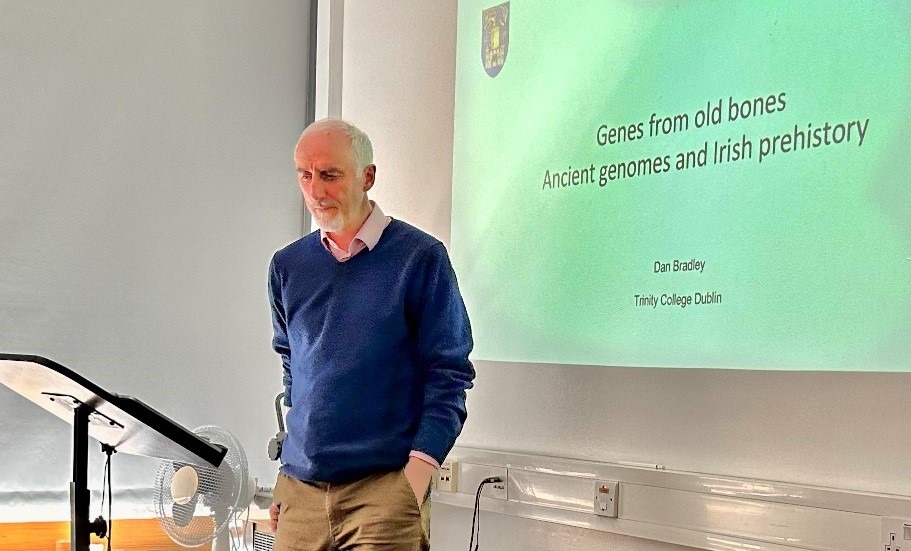
As family historians there comes a time in our research where we run out of records of past generations and many of us then turn to autosomal DNA testing to find relatives beyond what the records can tell us. But there is a world to be discovered beyond that again – the ancient migration patterns of our ancestors from Africa and the places in between – the ultimate answer to the question; “where do I come from?” That is now made possible by the relatively recent ability of scientists to extract DNA and specifically Y and mtDNA from ancient bodies found in archaeological digs worldwide. The findings of this new science has revolutionised our understanding of migration into Ireland during the bronze age about 4,500 years ago, the descendants of that migration making up the majority of the Irish genome today. The lab at the core of this cutting edge science in Ireland is the Molecular Population Genetics Lab at the Smurfit Institute of Genetics in Trinity College Dublin. It is managed by its founder Professor Dan Bradley and his colleague Dr. Lara Cassidy who have made intriguing (and startling) discoveries from the ancient DNA (aDNA) of bodies found in our archeological heritage such as Newgrange and Carrowkeel and new discoveries opened up by the construction of bypasses of Irish towns – and by even the construction of a carpark at a pub on Rathlin Island!
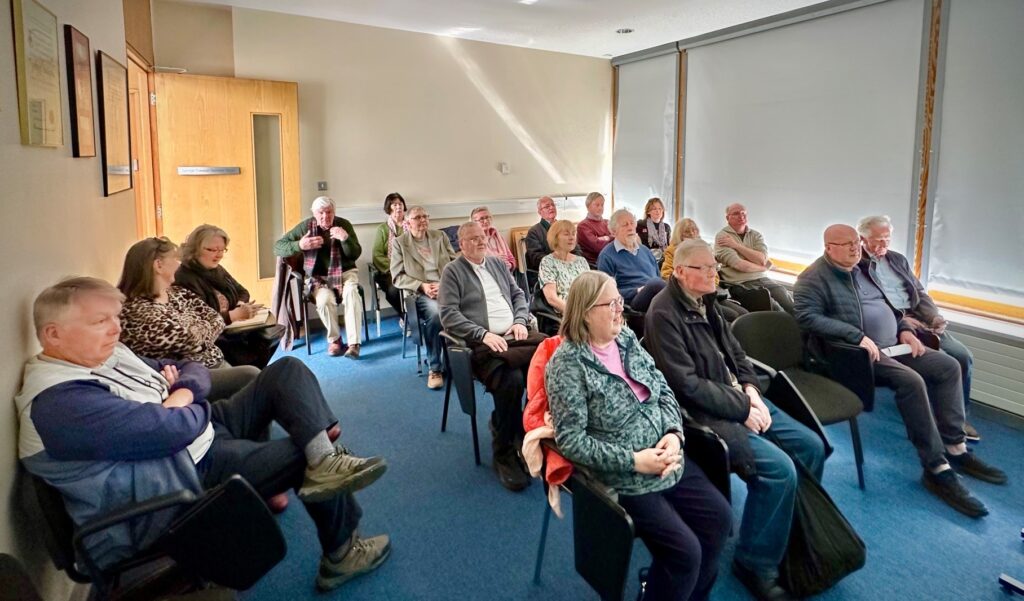
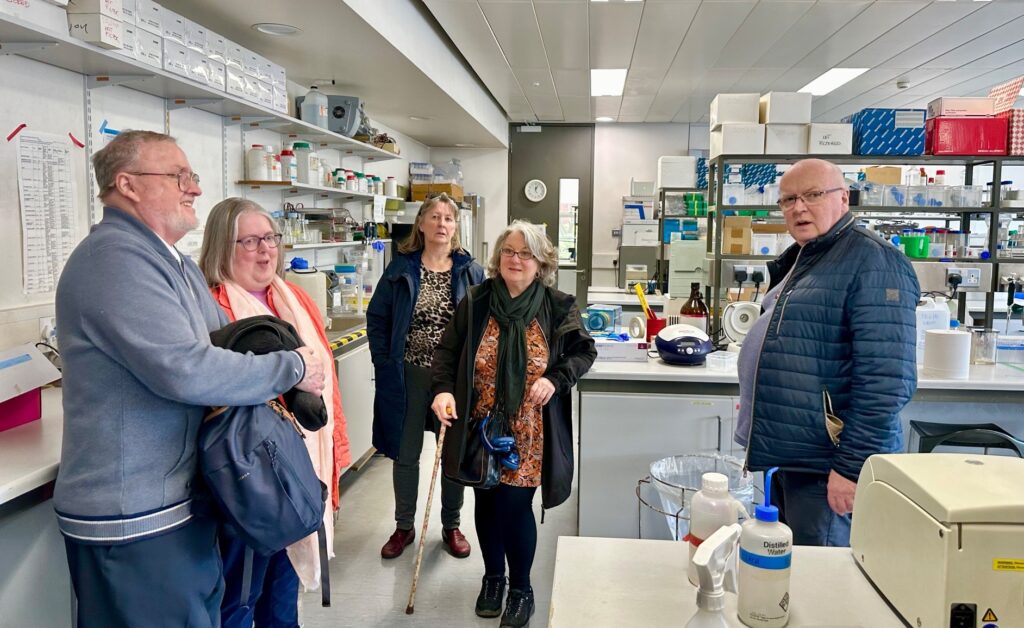
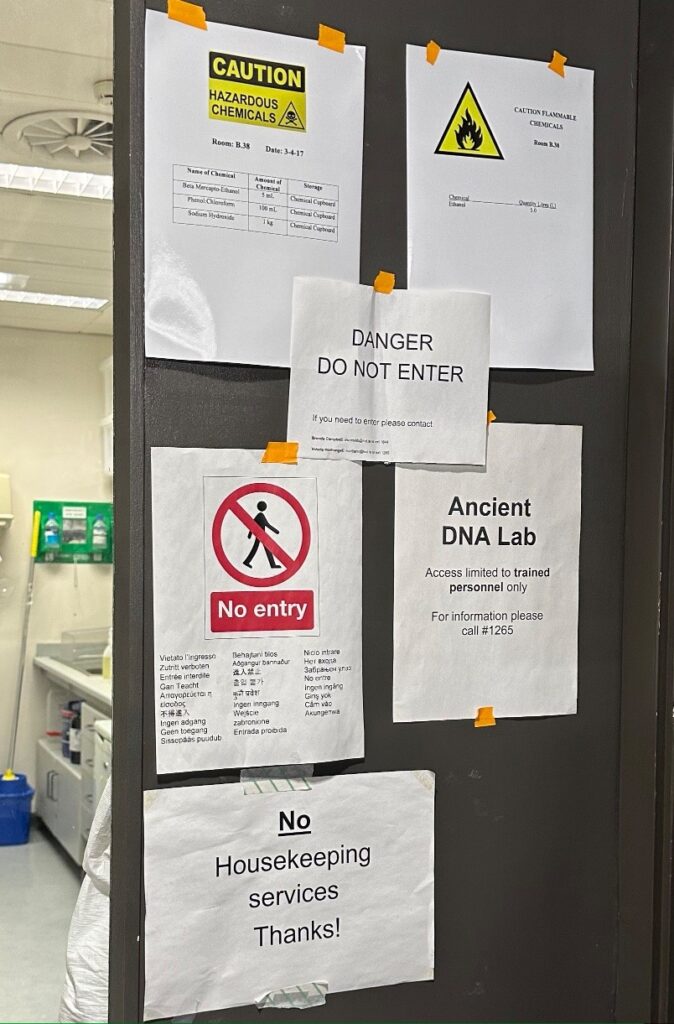
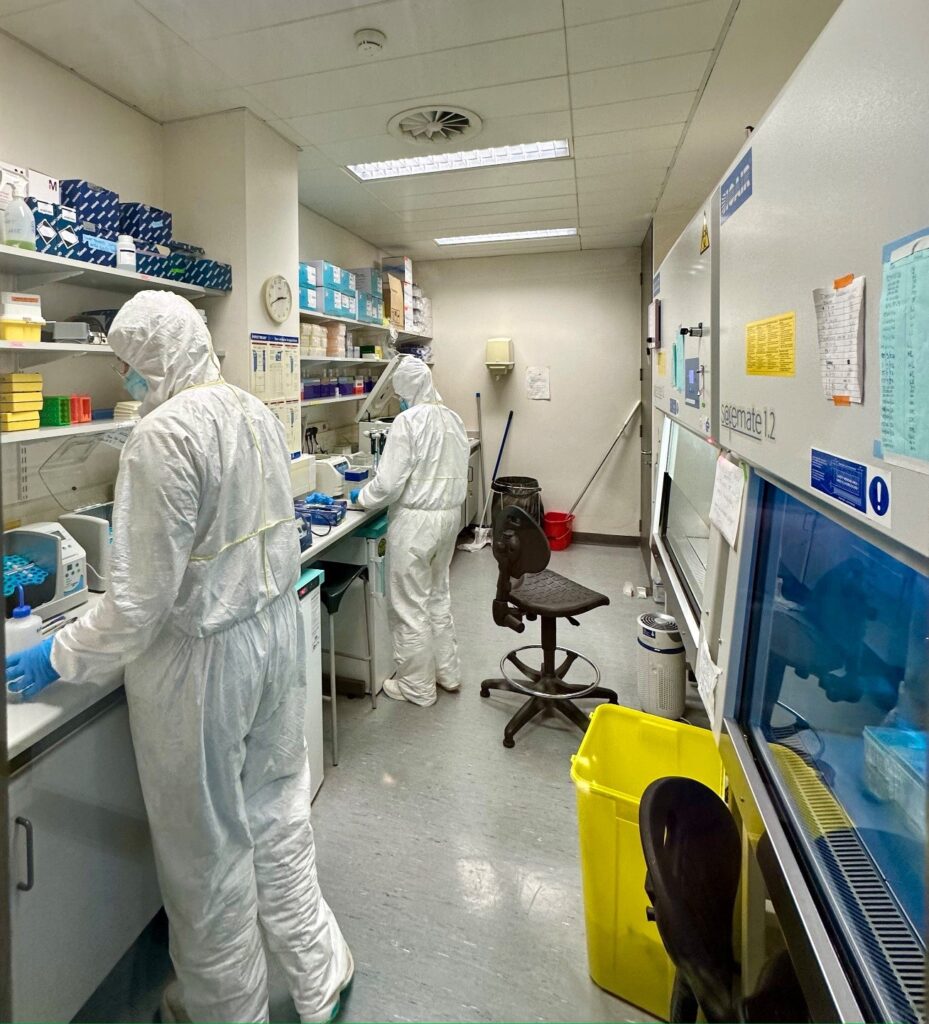
Professor Bradley very kindly offered to give us a presentation, which took place on 23 April, on his and his colleagues’ work on the ancient Irish genome and its migratory and medical implications, at his lab in Trinity. We got to look in the window of the DNA sequencing clean room as well!
Professor Dan Bradley biography
Dan Bradley was brought up on farm in Glen, Maghera, and after a degree in Genetics from Cambridge University and PhD in medical genetics from Trinity College Dublin he started to work on the genetics of each species present on that farm, including Irish humans, and has done for over 30 years. With his colleagues he has combined analysis of ancient and modern cattle to inform on the origins of these and other domesticates and pioneered the molecular genetic analysis of Irish populations. With his colleague Lara Cassidy, he leads the ancient DNA laboratory in Trinity College Dublin. He holds a Personal Chair in Population Genetics in Trinity and was awarded the 2020 Royal Irish Academy Gold Medal in the Life Sciences.

Rosaleen Underwood, member and professional genealogist, gave her lecture after the IFHS 2024 AGM.
SOME WEBSITES MENTIONED IN THE BELOW LECTURE SERIES HAVE BEEN UPDATED SINCE. THEREFORE SOME OF THE INFORMATION REGARDING CIVIL AND PARISH RECORDS MENTIONED IN THE HANDOUTS BELOW MIGHT NO LONGER BE FULLY UP TO DATE.
The IFHS organised a 6-part lecture series, presented by Kieran Jordan. The last instalment was about Findmypast and other websites.
The IFHS organised a 6-part lecture series, presented by Kieran Jordan. The fifth instalment was about Church records and Historic Maps.
The IFHS organised a 6-part lecture series, presented by Kieran Jordan. The fourth instalment was about The Civil Records and the Tithe Applotment Books.
The IFHS organised a 6-part lecture series, presented by Kieran Jordan. The third instalment was about Griffith’s valuation records.
The IFHS organised a 6-part lecture series, presented by Kieran Jordan. The second instalment was about census records.
The IFHS organised a 6-part lecture series, presented by Kieran Jordan. The first instalment was an introduction.
“Researching your Church of Ireland records” was the theme of the IFHS lecture that took place on Saturday 15 October 2022. The lecture was given by Sandra Doble, who holds a Diploma in Family History Research, awarded by the Independent Colleges and The Institute of Commercial Management, in conjunction with the Accredited Genealogists Ireland of which she became a member in 2015. Via the link below you can get a list of useful websites for researching your Church of Ireland records, which Sandra shared with the IFHS.
On 4 September 2021, Joan Sharkey, Honorary Treasurer of the Society, and a Member of AGI gave a detailed and very informative presentation on the Irish Roman Catholic Parish Records. A summary of the lecture with links to the archives and databases mentioned can be found below:
Paddy Waldron gave a talk at our AGM on the 10 March 2018 on How to get the most out of your DNA test results. He has kindly agreed to share his talk and you can see his handout here:
As part of the Society’s 2014 Autumn programme on Saturday 8th November 2014, Maeve Mullin spoke on Finding the Irish in WW1. For a copy of Maeve’s handout from her talk:
As part of the Society’s 2013 Autumn programme on Saturday 12th October 2013, Marie Boran and Brigid Clesham gave a talk on The Landed Estates Database: a resource for family and local history. Marie and Brigid have kindly agreed to include their handout on our website for the benefit of our members.
The Landed Estates Database: a resource for family and local history:
As part of the Society’s 2009 Autumn programme on Saturday 7th November, James Scannell gave a talk on The Remarkable Dr. James Drumm which he has kindly agreed to make his handout available on our website for the benefit of our members.
The Remarkable Dr. James Drumm.
Eileen M. D’ill, CG, MAPGI gave a talk to the Society on Saturday 3rd October 2009 on the fascinating topic of Forensic Genealogy: Locating Missing Heirs. Eileen says that “In recent years, genealogists have become increasing involved in the process of ‘heir locating’ particularly in intestate matters. Identifying the nearest next of kin and documenting their relationship to the deceased requires research skills and determination particularly in international cases. “
Eileen has very kindly given us permission to include a copy of her handout on our website.
Forensic Genealogy: Locating Missing Heirs.
On 18 April 2009 Conor and Liam Dodd gave an indept presentation on carrying out Military Research at The National Archives, Kew, England. Many Irish had family members who served in the British Army, Royal Navy and Royal Air Force, and the talk will be of particular interest to many of the Society’s members. Conor and Liam detailed the various sources available at Kew, many of which have been digitised and now available online at The National Archives own web site and also on some commercial sites.
For the benefit of our members who were unable to attend our meeting and in particular those from oversees, Conor and Liam have very kindly given us permission to make available on our website, a copy of their presentation and handout.
Military Research at The National Archives, Kew.
On 4 October 2008 John Hamrock, author of Tracing your Roscommon Ancestors, gave a talk to the Society on sources available for carrying out research into Roscommon ancestors. Many of the sources discussed will also be of interest to those researching in other counties. John has very kindly also given us permission to include a copy of his presentation and handout on our website.
A County’s Resources for Family History Research; the Roscommon Experience.